Saturday, 27 April 2019

Exam Tomorrow at 9.00 am

This is to confirm our exam time tomorrow Sunday.
  1. Starts - 9.00 am
  2. Ends - 11.00 am
  3. No one will be allowed to leave before the exam is over. 
  4. Read throuhg the BLOG. 
  5. Review the Words
  6. Prepare for Good Writing.
  7. Do NOT WASTE Exam Paper Space
  8. Turn off your Mobiles during exam.

Monday, 22 April 2019

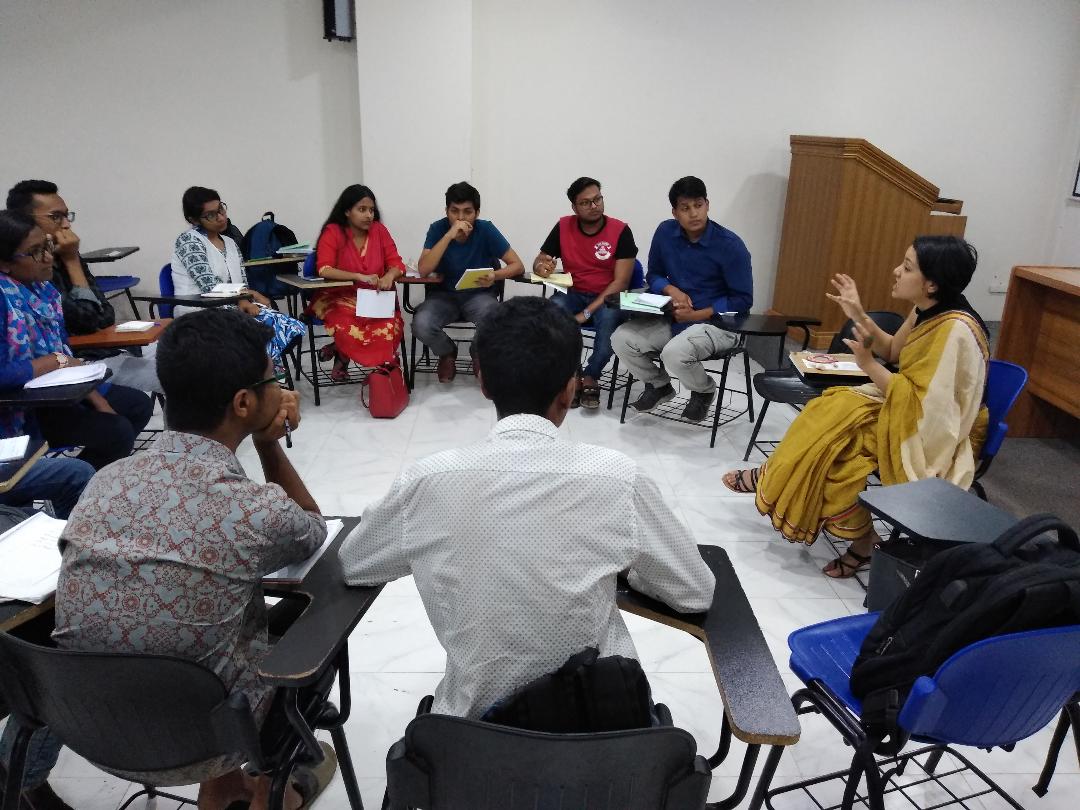
2nd Saturday Writing Wrkshop Concluded

This Saturday we had our 2nd Writing Workshop with Raidah B. Akber conducting the session. She talked about a great many things that covers how to be a good wiriter, the ways of improving your writing skills, how NOT to be intimidated (frightened) by your textbooks, what makes a critical thinker, how to improve your critical thing abilities, the uses of your critical thinking in your professional life. Raidah also briefed the participants about how she managed her very demanding courses in her own institutions. As part of her degree program, she had to take lessons in Classical Latin, Russian, French language. I am sure that this will work as a great confidence boosters for everyone who will have to take a third languge in your next semester. 

Ms. Raidah divided her talk roughly into following themes:
  • Think about it connect it, relate it with many other things. Creating link between 
  • Using Metaphors for Critical Thinking
  • disconnected thoughts is creativity.
  • How NOT to use "I feel" or "I would" in academic Writing.
  • While reading AVOID imagination
  • While writing, USE imagination
  • Take time to prepare for Exam
  • Read - Read - Read method.


Ms. Raidah was very impressed with the quality and motivation level of the participants and especially mentioned their performance when we met the Departmental Chairman at his office. The Chairman was genuinely exicited about the Workshop activities and "honestly & sincerely" expressed his desire to join one such session, which he termed as "Creative Writing." He is also of the opinion that such writing experiences will significantly improve quality of writing among students. Hopefully, we will get a this distinguished Fellow as a workshop participant when we meet for creative writing.

In 2nd Saturday Writing Workshop, following participants took part.

Touhid Hasan
Moshabbir Khan
Shahab Uddin
Rejoun Sharif
Shaikat Dev
Ebne Al Maruf
Ayasha Siddika Binti
Kazi Noor AHmed
Saimum Sairus
Shaonti Dev
Sadia Islam
IMPORTANT ANNOUNCEMENT

I was thinking that the 2nd Saturday Writing Workshop might be our last workshop in this semester. However, all participants demanded that there should be at least ONE MORE Workshop to discuss how to read a Long+Difficult chapter from textbook materials. In response to this I will conduct a Final Saturday Workshop on 27th April. No new application for participation will be possible. And participation without prior approval is discouraged. 

A lot of thanks to Ayasha Siddiki Binti for coordinating a number of essential things on behalf of the workshop. 

Thursday, 18 April 2019

Saturday WORKSHOP | Our Co-host Raidah B. Akber

We had our first Saturday Writing Workshop on 6th April. Our 2nd Saturday Writing Workshop will be held this Saturday at 4.00 pm because I understand that there is a Mid-tern exam till 3.30 pm. I am expecting all the Original Participants and two new participants Shaonti Dev and Saimum Sairas.

This Saturday's Writing Workshop (20th April) will be Co-hosted by Ms. Raidah B. Akber, currently a student of B.A. English at the Mount Holyoke College, Massatusetts, USA. She is currently in Dhaka on leave. She recently completed a Summer Program on Comparative Religion at the Oxford University, UK. She has extensive interest in Writing and had been part-timer at the world famous Emily Dickinson Museum located at South Hadley, MA. I hope you will enjoy her talk. She is interested in the following items. Please forward me any question from the list below, so that I can forward your Questions to her.   

❏ Writing, ❏ Critical thinking, ❏ Public Speaking, ❏ Peer counselling, ❏ Correspondence
❏       Communication, ❏ Teamwork, ❏ Budgeting, ❏ Management

Sunday, 14 April 2019

Writing a Report

Here is an item on which we shall write a report. For your convenience, I am putting in some subheadings -
  1. Date and ocassion , Organizer's profile
  2. Speaker and Topic
  3. Area Definition
  4. Participant's Questions
  5. What the participants came to know


Our WORKS Today

We shall work on the following items today.
  1. Vocabulary - Business & General [selections from Newsp
  2. Understanding Reality
  3. Writer's Loneliness - based on Rachel Carson's comments
  4. Report Writing
  5. Announcement of the REPORT on Annual Students' Gathering - submitted by Sanjay and Ayasha
  6. Introduction to Reading 3 Novels
Old Man and the Sea is a very short Novella of about 47 pages by Earnest Hemingway, who received nobel price for his Novels. This can be your first reading as it will take less than 3 hours to read. 

This post is primarily about On the Question of REALITY: ment for Saimum

Saimum wrote me a short mail and began with asking "How do we define reality?" He attempted to answer this Question by elaborating on some of the topics such as 'Brain-signals', 'Five sense', 'fish in an aquarium', 'Universal Reality', 'really exist or not.' When a person starts thinking about these categories, it is an indication that the person is thinking critically. Saimum's situation is more like Saira Banu in PADOSAN. Now, to make the matter worse, here is a Bengali article on the question of What is Reality? The example is taken from famous Hindi Film Padosan. The article was published in PROTHOM ALO literature page. 


In this Bengali article the writer gave reference to "Epiphany", "Appearance of Reality", "Gazing at Truth", Plato's Allegory fo the Cave etc. A MUST-read for those who are interested in finding out Where are We?
There is a brief description of Plato's Allegory of the Cave on page 76-77 in Sophie's World. However, the description is hugely summarized. So, the FULL coverage can be found HERE. So, what will happen when Bindu (Saira Banu) will come out of her cave of "perceived reality"? (1) Well, according to Philosopher Kant, she will NOT see the original thinker or "Thing in Itself". This is something we can imagine but can NEVER find. (2) Philosopher Heiddegar might say that Bindu will transform into "Being" because unless you are completely changed, you cannot see the TRUTH. (3) According to Philosopher Foucauld, Bindu will enter the house but will not see the actual singer - she will cast her "Gaze" on Vola and only gradually turn her "gaze" on Bidyapati, the actual singer.

Now, here is a graphic representation of the Cave. I hope you will like it! And Saimum, please go through the page No 198 of Sophie's World, where Descartes says that it is not proper to trust our own senses. And thank you for provoking me to wite this post.

Wednesday, 10 April 2019

10 Reading Comprehension Strategies (Reading Time: 15 min) - Melissa Kelly-র লেখা এই অনলাইন প্রবন্ধটিতে FSD-3 এর জন্য প্রয়োজনীয় পরিবর্তন করা হয়েছে

"They don't understand what they are reading!" laments the teacher.
"This book is too hard," complains a student, "I'm confused!"
Statements like these are commonly heard in classrooms, and they highlight a reading comprehension problem that will connect to a student's academic success. Such reading comprehension problems are not limited to the low level reader. There are several reasons that even the best reader in class may have problems understanding the reading that a teacher assigns.
One major reason for a lack of understanding or confusion is the course textbook. Many of the content area textbooks in middle and high schools are designed to cram as much information as possible into the textbook. This density of information may justify the cost of textbooks, but this density may be at the expense of student reading comprehension. 
Another reason for a lack of understanding is the high-level and content-specific vocabulary (business, psychology, science, social studies, etc) in textbooks, that results in an increase in a textbook's complexity. A textbook's organization with sub-headings, bolded terms, definitions, charts, graphs coupled with sentence structure also increase complexity. 
The same can be said for the wide range of reading for students in English classes that contributes to low reading comprehension. Students are assigned reading from the literary canon including works by Shakespeare, Hawthorne, and Hemingway. Student read literature that differs in format (drama, epic, essay, etc). Students read literature that differs in writing style, from 17th Century drama to the Modern American novel such as Great Gatsby.
This difference between student reading levels and text complexity suggests increased attention should be given to teaching and modeling reading comprehension strategies in all content areas. Some students may not have the background knowledge or maturity to understand material written for an older audience. In addition, it is not unusual to have a student with a high Lexile (vocabulary) readability measure encounter problems with reading comprehension because of his or her lack of background or prior knowledge, even with a low Lexile text.
Many students struggle trying to determine the key ideas from the details; other students have a hard time understanding what the purpose of a paragraph or chapter in the book may be. Helping students increase their reading comprehension can be a key to educational success or failure. Good reading comprehension strategies, therefore, are not only for low level readers, but for all readers. There is always room for improving comprehension, no matter how skilled a reader a student may be. 
The importance of reading comprehension cannot be understated. Reading comprehension is the result of many different mental activities by a reader, done automatically and simultaneously, in order to understand the meaning communicated by a text. These mental activities include, but are not limited to:
  1. Predicting the meaning of a text;
  2. Determining the purpose of a text; 
  3. Activation of prior knowledge in order to...
  4. Connect prior experiences to the text;
  5. Identify word and sentence meanings in order to decode the text;
  6. Summarize the text in order to create new meanings;
  7. Visualize the characters, settings, situations in the text;
  8. Question the text;
  9. Decide what is not understood in the text;
  10. Use strategies to improve understanding of the text;
  11. Reflect on the meaning of a text;
  12. Apply understanding of the text as needed.
Reading comprehension is now thought to be a process that is interactive, strategic, and adaptable for each reader. Reading comprehension is not learned immediately, it is a process that is learned over time. In other words, reading comprehension takes practice. Here are ten (10) effective tips and strategies that teachers can share with students to improve their comprehension of a text. 
01
of 10


Generate Questions

A good strategy to teach all readers is that instead of just rushing through a passage or chapter,  is to pause and generate questions. These can either be questions about what has just happened or what they think might happen in the future. Doing this can help them focus on the main ideas and increase the student's engagement with the material. 
After reading, students can go back and write questions that could be included in a quiz or test on the material. This will require them to look at the information in a different manner. By asking questions in this way, students can help the teacher correct misconceptions. This method also provides immediate feedback.
02
of 10


Read Aloud and Monitor

While some might think of a teacher reading aloud in a classroom as an elementary practice, there is evidence that reading aloud benefits university students as well. Most importantly, by reading aloud teachers can model good reading behavior.
Reading aloud to students should also include stops to check for understanding. Teachers can demonstrate their own think-aloud or interactive elements and focus intentionally on the meaning “within the text,” “about the text,” and “beyond the text” (Fountas & Pinnell, 2006. These interactive elements can push students for deeper thought around a big idea. Discussions after reading aloud can support conversations in class that help students make critical connections.
03
of 10


Promote Cooperative Talk

Having students stop periodically to turn and talk in order to discuss what has just been read can reveal any issues with understanding. Listening to students can inform instruction and help a teacher to can reinforce what is being taught. This is a useful strategy that can be used after a read aloud (above) when all students have a shared experience in listening to a text. This kind of cooperative learning, where students learn reading strategies reciprocally, is one of the most powerful instructional tools.
04
of 10


Attention to Text Structure

An excellent strategy that soon becomes second nature is to have struggling students read through all the headings and subheadings in any chapter that they have been assigned. They can also look at the pictures and any graphs or charts. This information can help them gain an overview of what they will be learning as they read the chapter. The same attention to text structure can be applied in reading literary works that use a story structure. Students can use the elements in a story's structure (setting, character, plot, etc) as a means of helping them recall story content.
05
of 10


Take Notes or Annotate Texts

Students should read with paper and pen in hand. They can then take notes of things they predict or understand. They can write down questions. They can create a vocabulary list of all the highlighted words in the chapter along with any unfamiliar terms that they need to define. Taking notes is also helpful in preparing students for later discussions in class. Annotations in a text, writing in the margins or highlighting, is another powerful way to record understanding. This strategy is ideal for handouts. Using sticky notes can allow students to record information from a text without damaging the text. Sticky notes can also be removed and organized later for responses to a text.
06
of 10


Use Context Clues

Students need to use the hints that an author provides in a text. Students may need to look at context clues, that is a word or phrase directly before or after  a word they may not know. Context clues may be in the form of:
  1. Roots and affixes: origin of the word;
  2. Contrast: recognizing how word is compared or contrasted with another word in the sentence;
  3. Logic: considering the rest of the sentence to understand an unknown word;
  4. Definition: using a provided explanation that follows the word; 
  5. Example or Illustration: literal or visual representation of the word;
  6. Grammar: determining how the word functions in a sentence to better understand its meaning.
07
of 10


Use Graphic Organizers

Some students find that graphic organizers like webs and concept maps can greatly enhance reading comprehension. These allow students to identify areas of focus and main ideas in a reading. By filling in this information, students can deepen their understanding of the author's meaning. 
08
of 10


Practice PQ4R

Four steps: (1) Preview, (2) Question, (3) Read, Reflect, Recite, and Review.
Preview has students scan the material to get an overview. Question means that students should ask themselves questions as they read.
The four R's have students read the material, reflect on what has just been read, recite the major points to help learn better, and then return to the material and see if you can answer the questions previously asked.
09 of 10 Summarizing
As they read, students should be encouraged to stop periodically stop their reading and summarize what they have just read. In creating a summary, students have to integrate the most important ideas and generalize from the text information. They need to distill the important ideas from the unimportant or irrelevant elements.
This practice of integrating and generalizing in the creation of summaries make long passages more understandable. 
10
of 10

Monitor Understanding

Some students prefer to annotate, while others are more comfortable summarizing, but all students must learn how to be aware of how they read. They need to know how fluently and accurate they are reading a text, but they also need to know how they can determine their own understanding of the materials. They should decide which strategies are most helpful in making meaning, and practice those strategies, adjusting the strategies when necessary.